
Visit to BRUMMER
 Go back
 Visit to BRUMMER
 October 13, 2026
  10:30 a.m. – 12:00 p.m.
  BRUMMER Logistik, Marienkirchen, Austria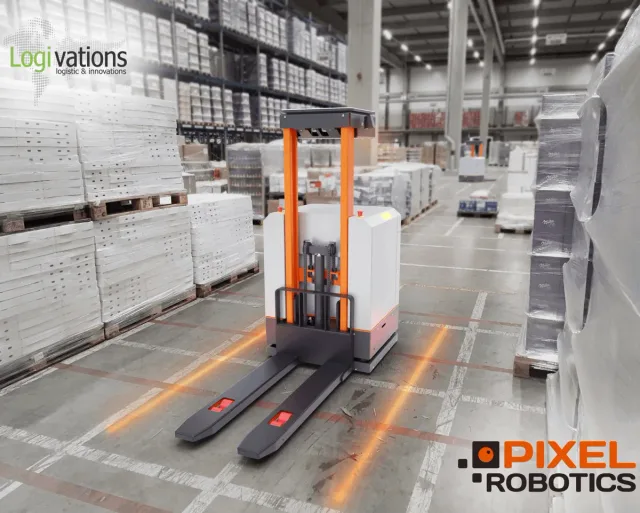
Find or contact us:


The event is intended for companies that would like to see our mobile robots working together with our software in live operation.
In focus: “Autonomous Transport Robot Pixel PT & AI-based Navigation”
- The robot “sees” the work: automatic order generation by detecting transportable pallets with the camera system from a bird’s eye view.
- The robot is a team player: works together with human colleagues – even in the same process. The robots carry the base load; when orders peak, their human colleagues step in. That keeps the robots fully utilized and makes the automation pay off.
- Automatic identification of the pallets that can be moved – the labels are found and read, and the destination is looked up in the warehouse management system on the fly.
- The innovative, AI-based fork detection recognizes and drives around forklift forks. Unlike conventional 3D cameras, it is robust against uneven floors.
- The robot adapts to the conditions of hybrid operation: even pallets standing at an angle or offset are found and picked up. Staff can keep working the way they always have.
- Cooperation within the fleet: the robots are trained to coordinate with one another – and with their human colleagues – for the efficiency of the operation as a whole, even in large fleets.
- A robot works half as fast as a human – but for up to 21 hours a day.
Other topics:
- Digital real-time twin: The camera system can not only detect robots, but also all other objects in the hall – transparency of all processes and 100% inventory accuracy at all times
- Fleet and area management with W2MO (Partner Logivations GmbH)
- Digital Twin with W2MO (Partner Logivations GmbH)
- Safety applications (Partner Logivations GmbH)